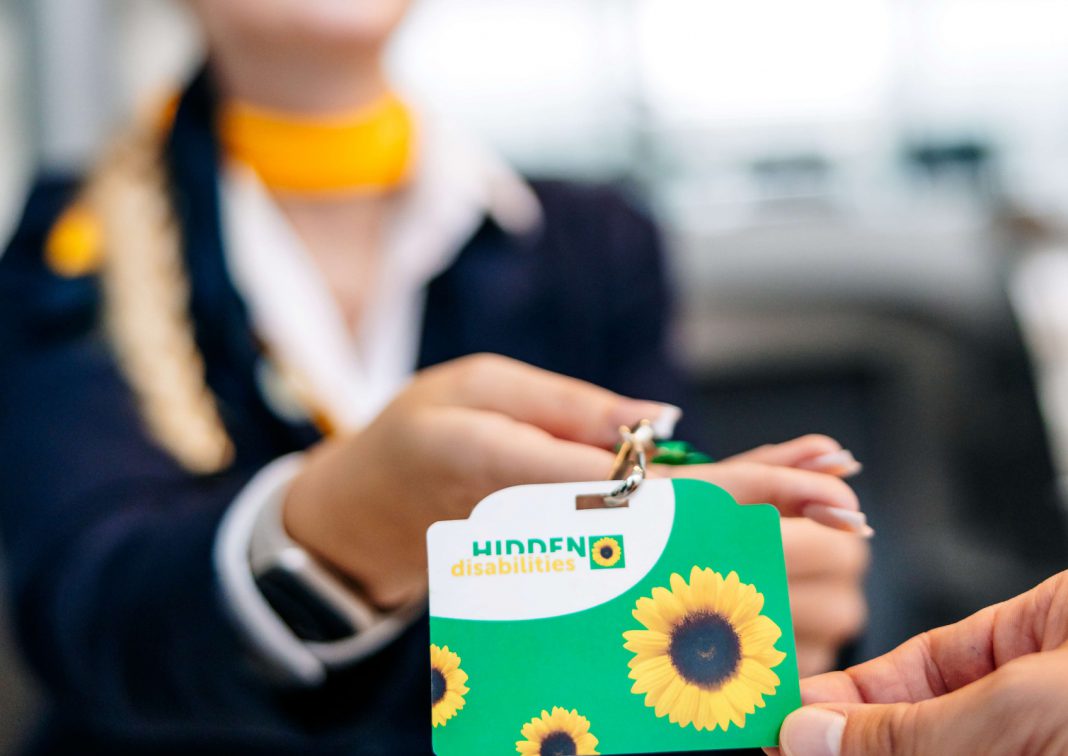
Lufthansa joined the Hidden Disabilities Sunflower Program on December 1. The global program to support people with invisible disabilities enables affected individuals to discreetly indicate their needs in public spaces. The symbol is a yellow sunflower on a green background, usually in the form of a lanyard with a pendant. The “Sunflower” is used in many public, high-traffic locations such as airports, train stations, supermarkets, theaters, and universities. The Lufthansa Group’s goal is to have all its airlines join the program by the end of 2026. Austrian Airlines, Eurowings, SWISS, and now Lufthansa are already on board.
Around 1.3 billion people worldwide live with some form of disability. Up to 80 percent, over a billion of them have an invisible disability such as chronic illness, mental health issues, or sensory impairments. Air travel can be particularly challenging for these individuals. The Sunflower symbol allows affected individuals to discreetly indicate that they need more time, patience, help, or understanding in certain situations. Of course, they decide for themselves whether they want to make use of this offer. In recent weeks, Lufthansa has provided its ground and cabin crews with comprehensive information and training on the Sunflower Program and raised their awareness of the issue and how to interact with passengers who wear the Sunflower.
Implementation of the program at Fraport and FMG
The Sunflower Program will also be implemented at Lufthansa’s two home airports – as of now in Munich, and in Frankfurt from January 2026. The Sunflower lanyards will be available at the information or special services counters at the airports from the dates mentioned above and will also be issued at the Lufthansa special services counters in Frankfurt and Munich. Passengers with non-visible disabilities can always contact airport and Lufthansa staff, even if they are not wearing a Sunflower identification badge. Wearing the lanyard does not replace an escort or wheelchair service, nor does it allow for preferential or faster progress, for example, at check-in, security checks, or boarding. Rather, it is about awareness, respect, and empathy at all points of contact.
There are currently numerous initiatives within the Lufthansa Group to improve the travel experience for people with impairments or disabilities. In November, Lufthansa invited to the first Accessibility Customer Advisory Committee at its headquarters in Frankfurt. Members with limited mobility, visual and hearing impairments, as well as cognitive impairments and with corresponding accessibility requirements, are represented in the newly founded committee. They will support the Lufthansa Group with their observations, experiences, and ideas in order to further develop existing offers, products, and services for people with visible and invisible disabilities.